The Handwriting Renaissance: How Fonts Like Birthday Dream Are Redefining Creative Expression
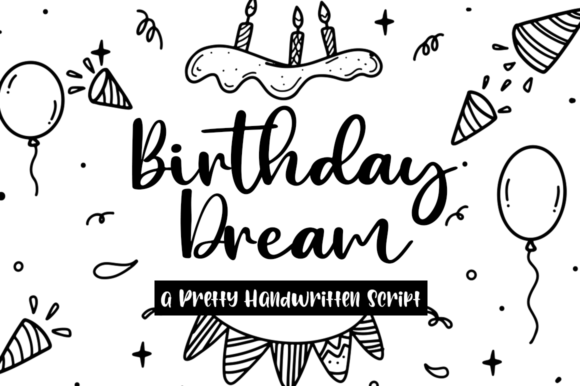
Typography has always been more than a practical vessel for words. It carries mood, signals intent, and establishes an emotional contract with the viewer before a single sentence registers cognitively. In recent years, the creative landscape has witnessed a pronounced shift away from sterile precision and toward warmth, imperfection, and the unmistakable imprint of the human hand. At the center of this movement sits a charming little font called Birthday Dream — a cute, relaxed handwritten typeface that encapsulates everything designers, entrepreneurs, and creators are searching for in an era hungry for authenticity.
What makes Birthday Dream noteworthy is not simply that it is dainty and joyful, though those qualities certainly define its immediate aesthetic appeal. The font matters because it represents a larger recalibration of how we think about personalization, emotional design, and the tools we choose to communicate intimacy in an increasingly digital world. Understanding why a font like this gains traction reveals deeper truths about consumer expectations, creative workflows, and the economics of visual identity.
The Emotional Economy of Type Choices
Design decisions are rarely neutral. Every curve, ligature, and baseline shift in a typeface communicates something. When a wedding invitation designer selects a font, they are not merely picking letters — they are curating an atmosphere. Birthday Dream occupies a specific emotional territory that many modern creatives find indispensable. It is simultaneously playful and refined, spontaneous yet legible, whimsical without crossing into childishness. That balancing act is harder to achieve than most people realize.
The broader market has been moving toward what some design researchers call "affective typography" — typefaces engineered to provoke specific emotional responses rather than simply fulfill functional readability requirements. Handwritten fonts, in particular, have surged in popularity across greeting card design, boutique branding, social media graphics, and personalized stationery. The reason is straightforward: consumers increasingly reward brands and creators who feel human, approachable, and genuine. A sleek sans-serif might convey professionalism, but it rarely communicates warmth. This is precisely where Birthday Dream finds its niche. Its relaxed character suggests a personal touch — the sense that someone cared enough to craft something by hand, even if the final product was rendered digitally.
Handwritten Fonts and the Authenticity Imperative
We live in an age of mass production and algorithmic uniformity. Templates dominate. Automation scales. In response, a countercurrent has emerged that values the bespoke, the imperfect, and the unmistakably human. Handwritten fonts are not new, but their cultural significance has intensified. They serve as a visual shorthand for sincerity. When a brand uses a typeface like Birthday Dream, it signals something important: this message was made for you.
This phenomenon extends far beyond wedding invitations. Consider the explosion of direct-to-consumer brands that wrap their products in hand-drawn logos and script typography. Consider the influencer who layers handwritten overlays onto Instagram Stories to create intimacy with followers. Consider the entrepreneur who designs their own product packaging and reaches for a font that feels like a note from a friend rather than a corporate directive. Birthday Dream operates in this expansive territory, proving useful wherever a romantic, personalized touch is required. The font's dainty quality makes it ideal for romantic contexts, but its relaxed demeanor keeps it versatile enough for birthday cards, baby shower announcements, thank-you notes, and even boutique product labels.
From Wedding Suites to Brand Identities: Practical Applications
The most obvious applications for a font like Birthday Dream lie in the wedding industry, which has long understood the power of romantic typography. Wedding invitation suites demand fonts that feel celebratory yet elegant, and the handwritten aesthetic has dominated this space for years. Calligraphy-inspired fonts allow couples to achieve a bespoke look without the expense and logistical complexity of hiring a professional calligrapher. Designers who build invitation templates for marketplaces like Etsy or Creative Market regularly seek out typefaces that strike this delicate balance, and Birthday Dream delivers with its joyful, dainty character.
Yet the applications extend well beyond matrimonial stationery. Small business owners crafting their visual identities increasingly opt for handwritten fonts to differentiate themselves from corporate competitors. A bakery might use Birthday Dream on its menu boards and pastry labels. A florist might incorporate it into delivery cards and shop signage. A photographer might layer it across watermark designs and client galleries. In each case, the font performs emotional labor — convincing the customer that behind the business is a real person who cares about the details.
Social media content creators have also embraced handwritten fonts as essential tools in their visual arsenals. Instagram carousels, Pinterest pins, YouTube thumbnails, and TikTok text overlays all benefit from typography that feels casual and inviting. Birthday Dream fits seamlessly into these contexts, offering legibility at various sizes while maintaining its distinctive personality. For creators who monetize their audiences, visual consistency matters — and the right font selection contributes meaningfully to brand recognition and audience trust.
The Creator Economy and the Democratization of Design
One of the most significant shifts in the creative landscape over the past decade has been the democratization of design tools. Platforms like Canva, Adobe Express, and Figma have placed professional-grade capabilities into the hands of non-designers. This has created a vast new market of creators, entrepreneurs, freelancers, and small business owners who need accessible, attractive fonts that do not require advanced typographic knowledge to deploy effectively.
Birthday Dream speaks directly to this audience. It is a font that does not demand a design degree to use well. Its inherent charm carries the composition, forgiving minor layout imperfections that might glare in a more rigid typeface. For the Etsy seller designing her own product mockups, the freelance marketer building a client's email header, or the small-batch candle maker labeling her jars, fonts like this reduce the friction between intention and execution. They empower people who may not identify as "designers" to produce work that nevertheless feels designed — intentional, cohesive, and emotionally resonant.
This democratization has fueled a thriving marketplace for fonts. Independent type foundries and individual designers now release typefaces directly to consumers through platforms like Creative Market, Gumroad, and Envato. The barrier to entry for font creation has lowered, and the result is an ecosystem rich with variety, where niche aesthetics can find enthusiastic audiences. Birthday Dream exemplifies the kind of font that thrives in this environment: distinctive enough to stand out, versatile enough to sell widely, and priced accessibly for the independent creator market.
Typography as a Reflection of Changing Lifestyles
Font trends are never purely aesthetic. They reflect broader cultural currents. The rise of remote work, the explosion of digital entrepreneurship, and the growing importance of personal branding have all contributed to a design environment where the personal and the professional blend more freely than they once did. People do not necessarily want their invitations, their product packaging, or their social media presence to look "corporate." They want them to look considered.
The popularity of relaxed handwritten fonts like Birthday Dream also mirrors a wider societal turn toward comfort, softness, and emotional openness. The stark minimalism that dominated design thinking in the 2010s has softened. Rounded forms have replaced sharp angles. Warm color palettes have supplanted cool grays. Imperfection is not merely tolerated — it is celebrated. In this context, a font that is "cute and relaxed" is not a niche indulgence but a legitimate design asset aligned with prevailing cultural sensibilities.
Choosing the Right Handwritten Font: Context Matters
For all their appeal, handwritten fonts require thoughtful deployment. The very qualities that make Birthday Dream charming in a wedding invitation or a greeting card could undermine its effectiveness in a context demanding gravitas. A legal contract set in a dainty handwritten typeface would feel incongruous at best and untrustworthy at worst. The key is contextual awareness — understanding that fonts carry genre expectations and that violating those expectations should be a deliberate creative choice, not an oversight.
Professionals who work with type understand that legibility remains paramount, especially at smaller sizes. Birthday Dream performs admirably in this regard, maintaining clarity even when scaled down for envelope addressing or small-print details. Its relaxed spacing and consistent stroke weight contribute to readability, ensuring that its decorative qualities do not compromise its functional purpose. For designers building assets that will appear across multiple formats and resolutions, this balance is essential.
Another consideration is pairing. Handwritten fonts often shine brightest when contrasted with more structured typefaces. A common and effective strategy is to use Birthday Dream for headlines, names, or accent text while reserving a clean serif or sans-serif for body copy. This creates visual hierarchy and prevents the composition from feeling chaotic or overly saccharine. The font's joyful energy can then punctuate the design without overwhelming it.
What the Attention to Birthday Dream Tells Us About the Market
People are paying attention to fonts like Birthday Dream because they recognize something valuable: the power of small details to transform an ordinary communication into an experience. In a saturated media environment, differentiation matters. A handwritten font cannot singlehandedly rescue a weak design, but it can elevate a strong one — adding a layer of warmth and personality that generic typefaces simply cannot replicate.
This attention also reflects changing expectations around customization. Consumers and clients increasingly expect tailored experiences. They want to feel that something was made for them, not merely distributed to them. Fonts that evoke handwriting tap into this desire directly, borrowing the emotional resonance of a personal note even when produced at scale. For businesses, this offers an elegant solution to a persistent challenge: how to scale intimacy.
Looking forward, the appetite for handwritten and humanist typefaces shows no sign of diminishing. As artificial intelligence generates more of our visual content, the premium on perceived human touch will likely increase. Fonts that convey personality, warmth, and the suggestion of a human hand will remain essential tools for anyone seeking to cut through algorithmic homogeneity and connect with audiences on a more personal level.
Integrating Birthday Dream Into Your Creative Workflow
For designers, marketers, and entrepreneurs who want to incorporate Birthday Dream into their projects, the process is refreshingly straightforward. The font installs like any other and integrates with all major design software. Its character set typically includes standard glyphs, punctuation, and often a selection of stylistic alternates or ligatures that add variety and a more natural handwritten rhythm to repeated letter pairs.
Thoughtful usage means considering the emotional arc of the project. A wedding invitation suite might use the font for the couple's names and the date, letting its romantic quality anchor the composition. A product label might feature it prominently for the brand name while supporting information appears in a simpler typeface. A social media graphic might use it as the primary display type to create an approachable, friendly impression. The possibilities are extensive, bounded only by the designer's imagination and sense of contextual appropriateness.
Conclusion: The Lasting Value of Personal Typography
Birthday Dream is more than a font. It is a symptom of a design culture that increasingly values emotion, authenticity, and human connection. Its cute, relaxed, and dainty character makes it an ideal choice for wedding invitations, cards, and any project requiring a romantic, personalized touch. But its significance runs deeper. It embodies a shift in how creators think about the relationship between type and meaning, between visual form and emotional impact.
For the professionals, creators, entrepreneurs, and freelancers who shape our visual landscape, understanding fonts like this is not just a matter of expanding one's toolkit. It is about recognizing the signals that audiences respond to — and the quiet power of a letterform that looks like it was written by someone who cares. In a world of templates and automation, that sense of care remains irreplaceable. Birthday Dream reminds us, gently and joyfully, that typography can still feel personal.